Triton
Moon of Neptune
Neptune’s largest moon, the only large moon that orbits backwards, probably a captured object from the Kuiper Belt.
Key facts
- Orbits
- Neptune (backwards)
- Diameter
- About 2,707 km
- One orbit
- 5.9 days
- Surface temperature
- About −235 °C
- Discovered
- 1846, by William Lassell
About the Triton
How to recognise it
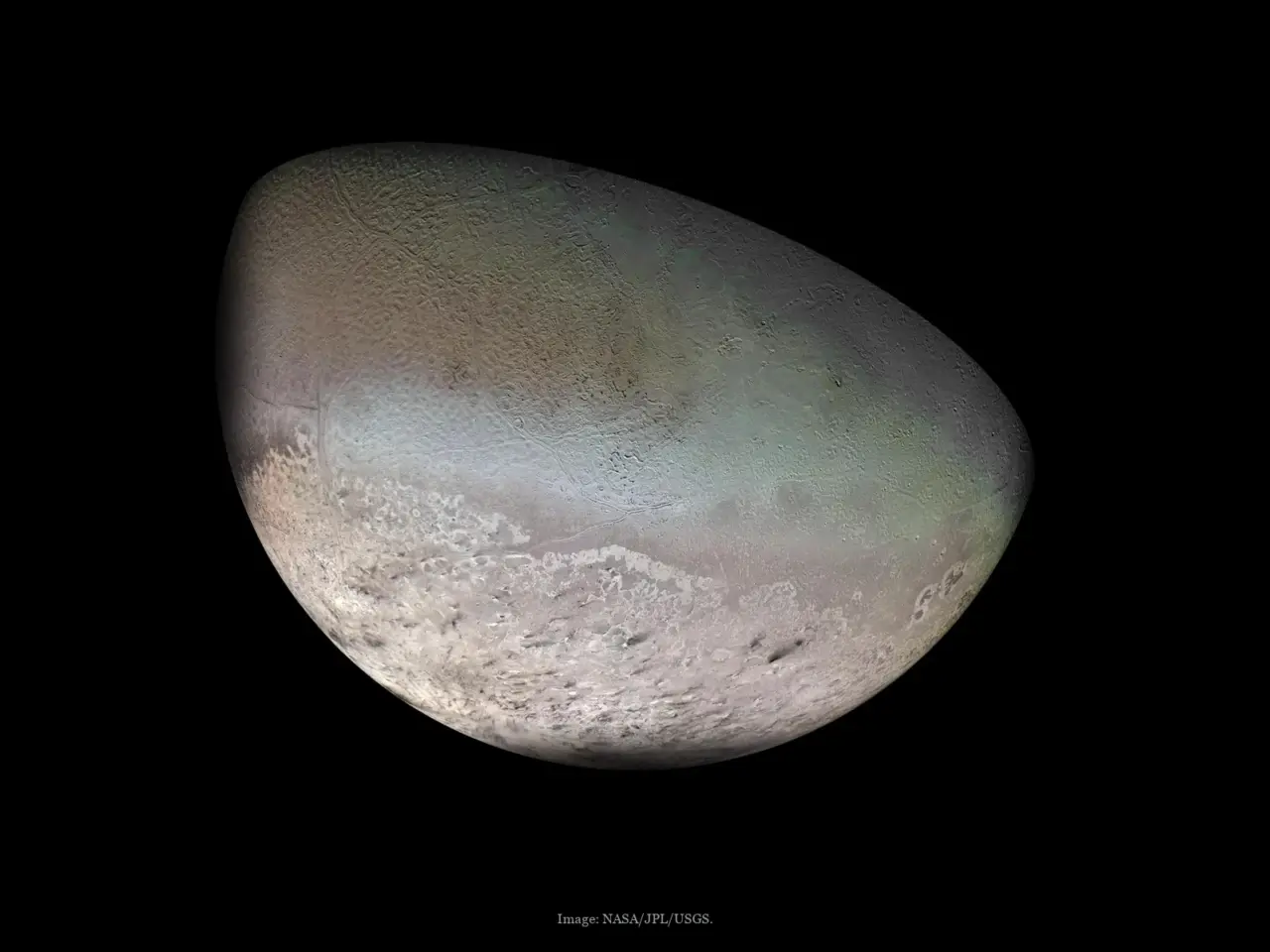
Triton has a pale, pinkish-tan icy surface. Our image, a mosaic from Voyager 2 in 1989, shows its south polar cap and a wrinkled region nicknamed cantaloupe terrain.
What makes it special
Triton is the only large moon in the Solar System that orbits in the opposite direction to its planet’s spin. Scientists think Neptune captured it from the Kuiper Belt. Voyager 2 found active geysers, and measured a surface temperature of about −235 °C. William Lassell discovered Triton in 1846, just weeks after Neptune itself was found.
Sources
Facts checked: 29 October 2026