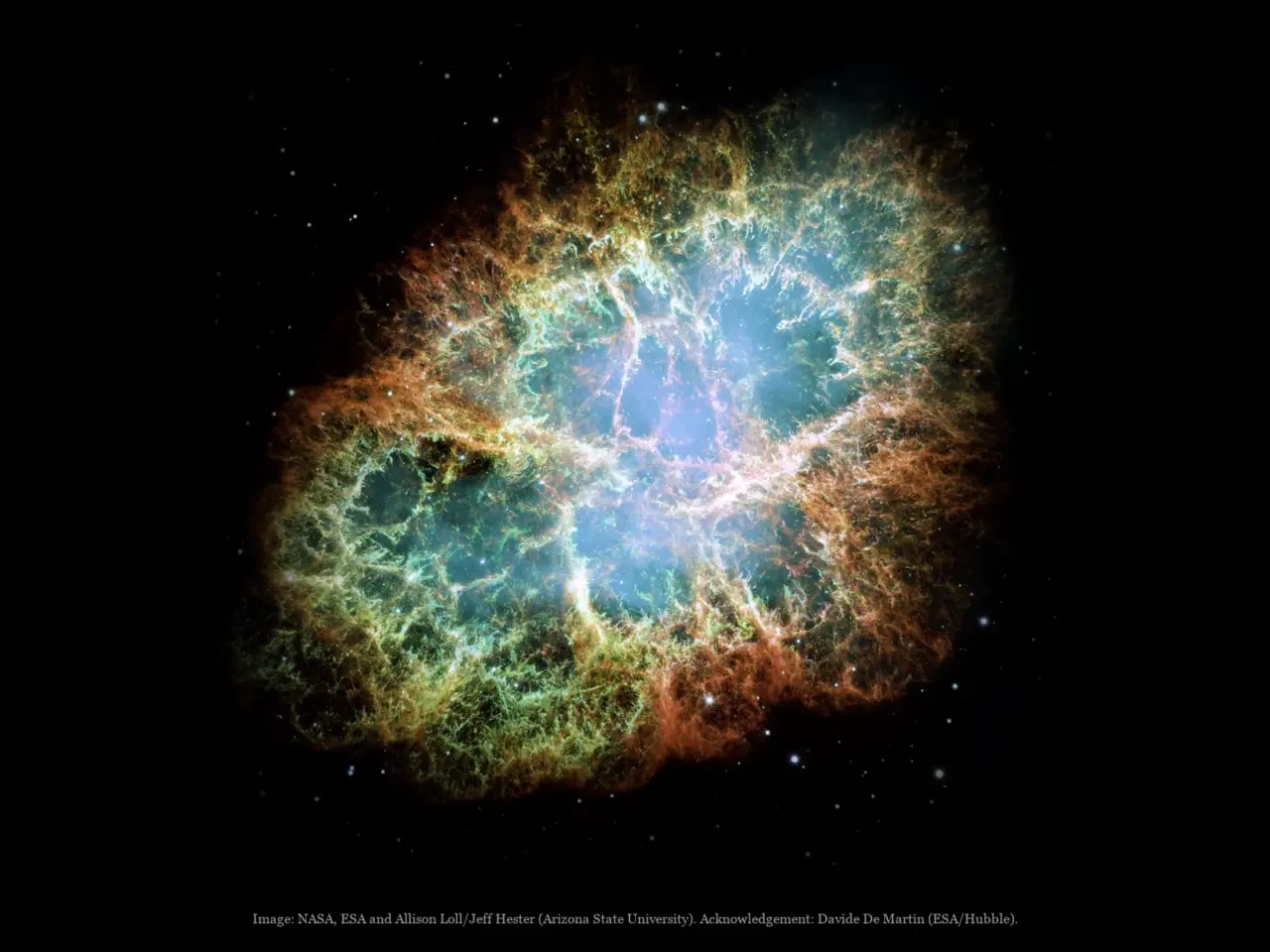
Supernova Remnant
Example: Crab Nebula (M1)
The expanding cloud of debris left after a massive star explodes as a supernova.
Key facts
- How it forms
- A massive star explodes as a supernova
- May contain
- A neutron star
- Example shown
- Crab Nebula (M1)
- Explosion seen
- 1054, recorded by Chinese astronomers
- Example’s distance
- About 6,500 light-years
About the Supernova Remnant
How to recognise it
Supernova remnants are tangled webs of glowing filaments spreading out from the site of a stellar explosion. At the centre there may be a neutron star, the collapsed core of the star that exploded.
The example: the Crab Nebula
In 1054, Chinese astronomers recorded a new “guest star” bright enough to see in daylight for about a month. Its remains are the Crab Nebula, about 6,500 light-years away and now about six light-years across. At its centre is a neutron star spinning about 30 times a second.
Sources
- NASA Hubble Messier Catalog: Messier 1
- ESA/Hubble: The Crab Nebula
- NASA Space Place: What is a nebula?
Facts checked: 29 October 2026